Four principles to remember when you find yourself between a rock and a hard place:
1. The Lord sovereignly directs all things for His glory and our good (14:1-9)
2. Our fears are the enemy of our faith (14:10-14)
3. Nothing is too difficult for the Lord (14:15-29)
4. Seeing the Lord’s delivering power increases our faith and fuels our worship (14:30-31)
Four lessons for the liberated:
1. God calls us to remember and recount His mighty acts of deliverance (vv. 1-16)
2. God often leads us by an indirect route (vv. 17-18)
3. God always fulfills His promises (v. 19)
4. God leads, protects, and comforts us with His unceasing presence along the way (vv. 20-22)

Source: Moody Bible Atlas
Six priority principles for pilgrims:
1. Faith lived out in obedience brings deliverance (v. 28)
2. Death comes for all (vv. 29-30)
3. Nations may rage, but will most certainly relent (vv. 31-32)
4. Where Yahweh guides, He provides (vv. 33-36)
5. The Exodus proves God’s promises are always fulfilled precisely (vv. 37-41)
6. The Jewish Passover lamb points unbrokenly to Jesus’ sacrifice for us and the nations (vv. 42-51)
Four ways in which Jesus’ Last Supper in Luke 22:14-20 has lasting significance for us in the Lord’s Supper:
1. Jesus’ Last Supper demonstrates His great love for us and the Lord’s Supper reminds us of this great love (v. 15)
2. Jesus’ Last Supper holds out the promise of a future supper in the kingdom, a promise repeated in the Lord’s Supper (vv. 16, 18-19)
3. Jesus’ Last Supper transforms Passover into the Lord’s Supper (vs. 19-20)
4. Jesus’ Last Supper beautifully pictures the gospel, a picture repeated at every Lord’s Supper (vv. 19-20)
Three important events explained by the Lord:
1. The plague of the death of the firstborn explained (11:1-10)
2. The feast of Passover explained (12:1-13)
3. The feast of Unleavened Bread explained (12:14-27)
Three important lessons for us as we consider the tenth plague:
1. In the ten plagues, the Lord demonstrated and proved His sovereign rule over gods, nations, human life, kings, citizens, weather, rivers, animals, insects, crops, disease, and even light and darkness
2. The substitutionary sacrifice of the Passover lamb points us clearly to Jesus and His substitutionary sacrifice on the cross for our sins
3. The Passover feast has found its true fulfillment in the Lord’s Supper
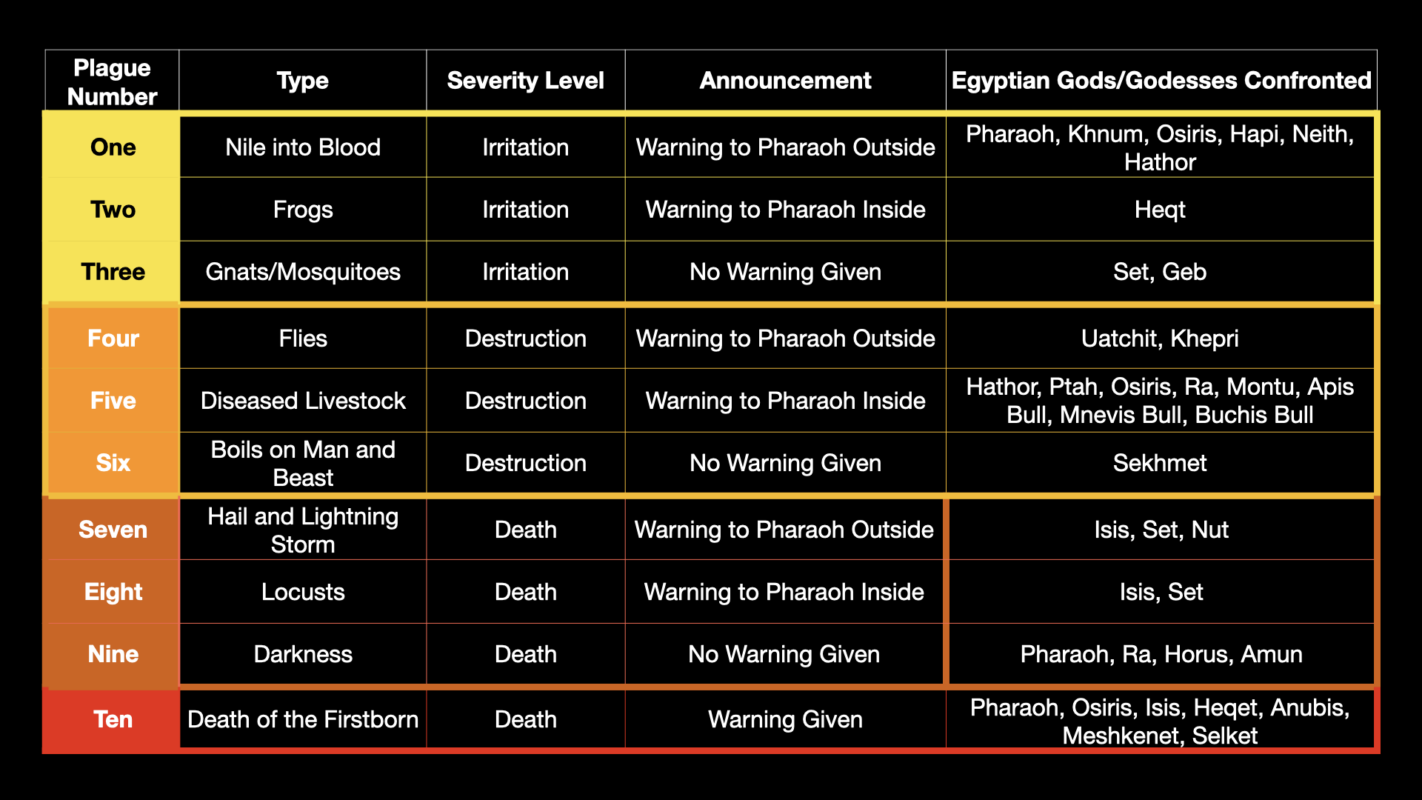
- Plague #7 – The Storm of Hail and Lightning (9:18-35)
- Plague #8 – The Swarming of Locusts (10:1-20)
- Plague #9 – The Descent into Darkness (10:21-29)
Four key lessons from plagues 7-9:
- The Lord has a purpose in all things, even in disasters and stubborn unbelief (9:14-16)
- It is foolish not to heed the Lord’s warnings (9:19)
- The fear of the Lord is the beginning of wisdom and the end of foolishness (9:30)
- Fighting against the Lord is useless, for sooner or later, everyone will acknowledge that the Lord is sovereign and rules over all (10:2-3)
- Plague #4 – The Swarming of Biting Flies (8:20-32)
- Plague #5 – The Death of Livestock in the Field (9:1-7)
- Plague #6 – The Torment of Boils (9:8-17)
Three Lessons we can learn from plagues four through six:
- False religion is Satanic and behind every false god is a demon
- If we are to be biblical Christians, we must have a worldview that makes room for the miraculous
- Prayer is effective and is an integral part of the outworking of God’s sovereign plan

The first three plagues:
1. The Nile is turned to blood
2. The Frog inundation
3. The scourge of mosquitoes
Three lessons we can learn from the first three plagues:
1. When leaders are wicked, the people suffer
2. Miraculous signs alone are insufficient to produce genuine repentance and saving faith
3. Repent of sin quickly to avoid successively harsher judgments
Five lessons we can learn about God’s sovereignty:
1. God is sovereign over the human heart (6:28-7:3a)
2. God is sovereign over nature (7:3b)
3. God is sovereign over all circumstances (7:4)
4. God is sovereign because He is Yahweh (7:5-7)
5. God is sovereign and can’t be matched or defeated (7:8-13)
21 Examples of God’s Sovereignty Over the Natural World by Paul Tautges
- He created and controls the seasons (Genesis 1:14; Psalms 74:16-17; 104:19).
- He raises the sun every morning (Psalm 104:19).
- He created, named, and leads the stars (Psalm 147:4; Job 38:32-33).
- He causes the wind to blow (Exodus 14:21; Job 28:25-27; Psalm 78:26; Jonah 1:4; Matthew 8:26-27; Mark 4:39-41; Luke 8:24-25; James 5:17-18).
- He created and controls the water cycle (Job 26:8-9; Job 5:10; Psalm 135:7; 147:8; Matthew 5:45; Acts 14:17; Joel 2:23).
- He sustains the earth (Job 5:10; Psalm 135:6).
- He sends the morning dew (Proverbs 3:19-20).
- He causes lunar eclipses (Job 26:8-9).
- He provides for the growth of grass and crops (Psalm 147:8).
- He sends lightning (Job 37:1-18; Job 1:16).
- He sends loud thunderstorms, which I love (Jeremiah 10:13; 1 Samuel 12:17-18).
- He sends hail and snow, ice and frost (Psalm 148:8; Job 38:22-30).
- He nourishes the earth so that it produces crops and fruit (Leviticus 26:4; Job 36:26-33; Deuteronomy 11:10-15; 28:12; Zechariah 10:1; Psalms 104:13-14).
- He brings the spring seed time and fall harvest (Jeremiah 5:24; Genesis 8:22; Deuteronomy 33:13-14).
- He paints the rainbow of His promise (Genesis 9:14-16).
- He sends earthquakes (Psalms 68:7-9).
- He provides plentiful pasture lands for livestock (Isaiah 30:23).
- He sends the scorching sun (Genesis 8:22; Jonah 4:8).
- He withholds rain, causing drought (1 Kings 8:35-36; 2 Chronicles 6:26-27).
- He will destroy the present earth with fire—the ultimate global warming (2 Peter 3:10).
- He will create a new heaven and a new earth where He will forever dwell with His redeemed ones (Revelation 21:1-5).
Credit: Paul Tautges, Blogpost
In times of doubt, we can receive six assurances through the precious promises of God:
- Assurance through the precious promise of God’s perfect timing (v. 1)
- Assurance through the precious promise of God’s name (vv. 2-3)
- Assurance through the precious promise of God’s covenant grace (v. 4)
- Assurance through the precious promise of God’s all-seeing compassion (v. 5)
- Assurance through the precious promise of God’s sovereign control of the future (vv. 6-8)
- Assurance through the fact that the precious promises of God are not dependent on the strength of our faith (vv. 9-27)